





Validation of immunoassay for protein biomarkers: bioanalytical study plan implementation to support pre-clinical and clinical studies
浏览次数:126 分享: 


Biomarkers have emerged as an important tool to optimize the benefit/risk ratio of therapeutics. The scientific impact of biomarker studies is directly related to the quality of the underlying data. It is therefore important that guidance be established for validation of assays used to support drug development. This paper specifically focuses on validation of immunoassay for protein biomarker to support pre-clinical and clinical studies. Therapeutics (small- and macro-molecules) and their respective target/ligand are out of scope. This paper describes the implementation of a bioanalytical study plan for the validation of immunoassays to support decision-making biomarkers and biomarker selection during preclinical and clinical studies. It establishes the complete operating procedure as well as the parameters and their respective acceptance criteria and defines milestones and decision points to be followed during the assay validation that should result in high quality bioanalytical data in a limited timeframe and with reduced costs. The bioanalytical study plan can be applied to the validation of a wild range of immunoassay technology such as monoplex ELISA, automated analyzer, multiplex assays or cutting edge technology. Before any validation, a feasibility study is performed to assess the performance of the immunoassay using biological samples which should mimic the clinical population. The feasibility study addresses the likelihood that an assay will be able to achieve its intended purpose with parallelism being the most critical element (milestone 1). At the end of the feasibility study, a decision is taken to either continue with the validation or change the assay (milestone 2). The milestone 3 consists of the establishment of the nominal value of quality control to be used during the validation. The quality controls used to validate an assay should preferentially be prepared using neat (non-spiked) biological matrix (ideally derived from the specific trial population). The last milestone (milestone 4), the formal validation, includes demonstration of the assay performance meeting accuracy and precision acceptance criteria within (intra-run) and between (inter-run) validation runs for each QC sample. Validation also includes the assessment of stability of the protein biomarker in the biological matrix. It is recognized that the extent of the validation should be correlated to the intended use of the data and the assay acceptance criteria should take into consideration the study objective(s), nature of the methodology and the biological variability of the biomarker.
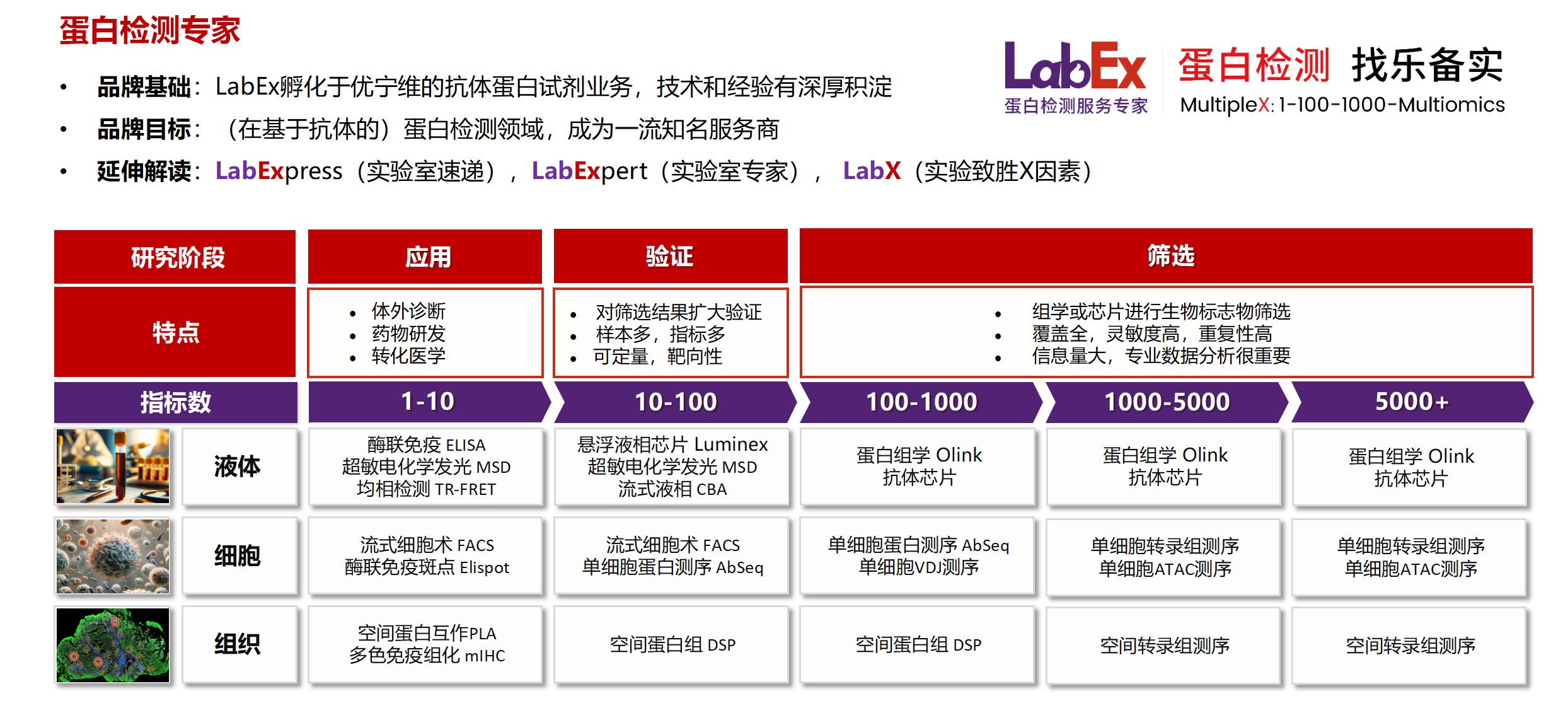
乐备实(上海优宁维生物科技股份有限公司旗下全资子公司),是国内专注于提供高质量蛋白检测以及组学分析服务的实验服务专家,自2018年成立以来,乐备实不断寻求突破,公司的服务技术平台已扩展到单细胞测序、空间多组学、流式检测、超敏电化学发光、Luminex多因子检测、抗体芯片、PCR Array、ELISA、Elispot、PLA蛋白互作、多色免疫组化、DSP空间多组学等30多个,建立起了一套涵盖基因、蛋白、细胞以及组织水平实验的完整检测体系。
我们可提供从样本运输、储存管理、样本制备、样本检测到检测数据分析的全流程服务。凭借严格的实验室管理流程、标准化实验室操作、原始数据储存体系以及实验项目管理系统,已经为超过3000家客户单位提供服务,年检测样本超过100万,受到了广大客户的信任与支持。
声明:本篇文章在创作中部分采用了人工智能辅助。如有任何内容涉及版权或知识产权问题,敬请告知,我们承诺将在第一时间核实并撤下。
详见LabEx网站(
www.u-labex.com)或来电咨询!
基因水平:PCR Array、RT-PCR、PCR、单细胞测序
蛋白水平:MSD、Luminex、CBA、Elispot、Antibody Array、ELISA、Sengenics
细胞水平:细胞染色、细胞分选、细胞培养、细胞功能
组织水平:空间多组学、多重荧光免疫组化、免疫组化、免疫荧光
数据分析:流式数据分析、组化数据分析、多因子数据分析
基因水平:PCR Array、RT-PCR、PCR、单细胞测序
蛋白水平:MSD、Luminex、CBA、Elispot、Antibody Array、ELISA、Sengenics
细胞水平:细胞染色、细胞分选、细胞培养、细胞功能
组织水平:空间多组学、多重荧光免疫组化、免疫组化、免疫荧光
数据分析:流式数据分析、组化数据分析、多因子数据分析
联系电话:4001619919
联系邮箱:labex-mkt@u-labex.com
公众平台:蛋白检测服务专家
联系邮箱:labex-mkt@u-labex.com
公众平台:蛋白检测服务专家




本网站销售的所有产品及服务均不得用于人类或动物之临床诊断或治疗,仅可用于工业或者科研等非医疗目的。

 沪公网安备31011502400759号
 营业执照(三证合一)

 labex-mkt@u-labex.com
 上海市浦东新区古丹路15弄18号楼4楼

请给“蛋白检测服务专家”公众号留言吧!我们客服当前在线哦