





Chondrogenic differentiation of synovial fluid mesenchymal stem cells on human meniscus-derived decellularized matrix requires exogenous growth factors
浏览次数:96 分享: 


The objective of this study was to investigate whether meniscus-derived decellularized matrix (DCM) has the capacity to induce differentiation of synovial fluid-derived mesenchymal stem cells (SF-MSCs) towards a meniscus fibrochondrocyte (MFC) phenotype. The potential roles of transforming growth factor beta-3 (TGF-β3) and insulin-like growth factor 1 (IGF-1) in the differentiation of SF-MSCs towards an MFC phenotype were also investigated. SF-MSCs were isolated via plastic adherence cell culture from the synovial fluid of five donors (5 male, average age 34 years). Porous DCM was generated by homogenizing and freeze-drying fresh normal human cadaveric meniscus tissue. SF-MSCs were seeded and cultured on the DCM scaffold in a defined serum-free media (SFM) supplemented with or without the combination of TGF-β3 and IGF-1. Cell pellets of SF-MSCs were cultured in SFM with either TGF-β3 or IGF-1 or their combination as controls. The duration of culture was 3 weeks for both experimental configurations. We assessed newly-formed tissues by biochemical assays, scanning electron microscopy (SEM), immunofluorescence and quantitative real-time PCR (qPCR). The combination of TGF-β3 and IGF-1 induced production of the cartilaginous matrix in DCM and upregulated the expression of aggrecan, collagens I and II. Moreover, the SF-MSCs exhibited a round morphology in the DCM scaffolds in the presence of the growth factors. In pellets, combined TGF-β3 and IGF-1 synergistically enhanced cartilaginous matrix production. In contrast to bone marrow mesenchymal stem cells (BM-MSCs), the differentiated SF-MSCs showed little evidence of the expression of the hypertrophic differentiation marker, collagen X. In conclusion, meniscus-derived DCM appears to require exogenous growth factor supplementation to direct differentiation of SF-MSCs. STATEMENT OF SIGNIFICANCE: Meniscus tears are the most common injury of the knee joint. These tears pose a major risk factor for the early development of knee osteoarthritis. Unfortunately, the majority of these tears occur in the inner region of the meniscus and lacks blood supply with no reparative or regenerative capacity. The goal of this study was to determine if the native extracellular matrix (ECM) of human meniscus has the capacity to differentiate human knee synovial fluid resident mesenchymal stem cells (SF-MSCs) towards a meniscus phenotype as a potential strategy to repair avascular meniscal tears. Our findings show that the human meniscus-derived ECM without supplementation with growth factors (TGF-β3 and IGF-1) cannot differentiate SF-MSCs towards a meniscus phenotype. The use of meniscus-derived scaffolds as a material to stimulate endogenous repair of meniscus tears via differentiation of SF-MSCs may require supplementation with TGF-β3 and IGF-1.Keywords: Decellularized matrix; Meniscus; Stem cells; Synovial fluid; Tissue engineering.
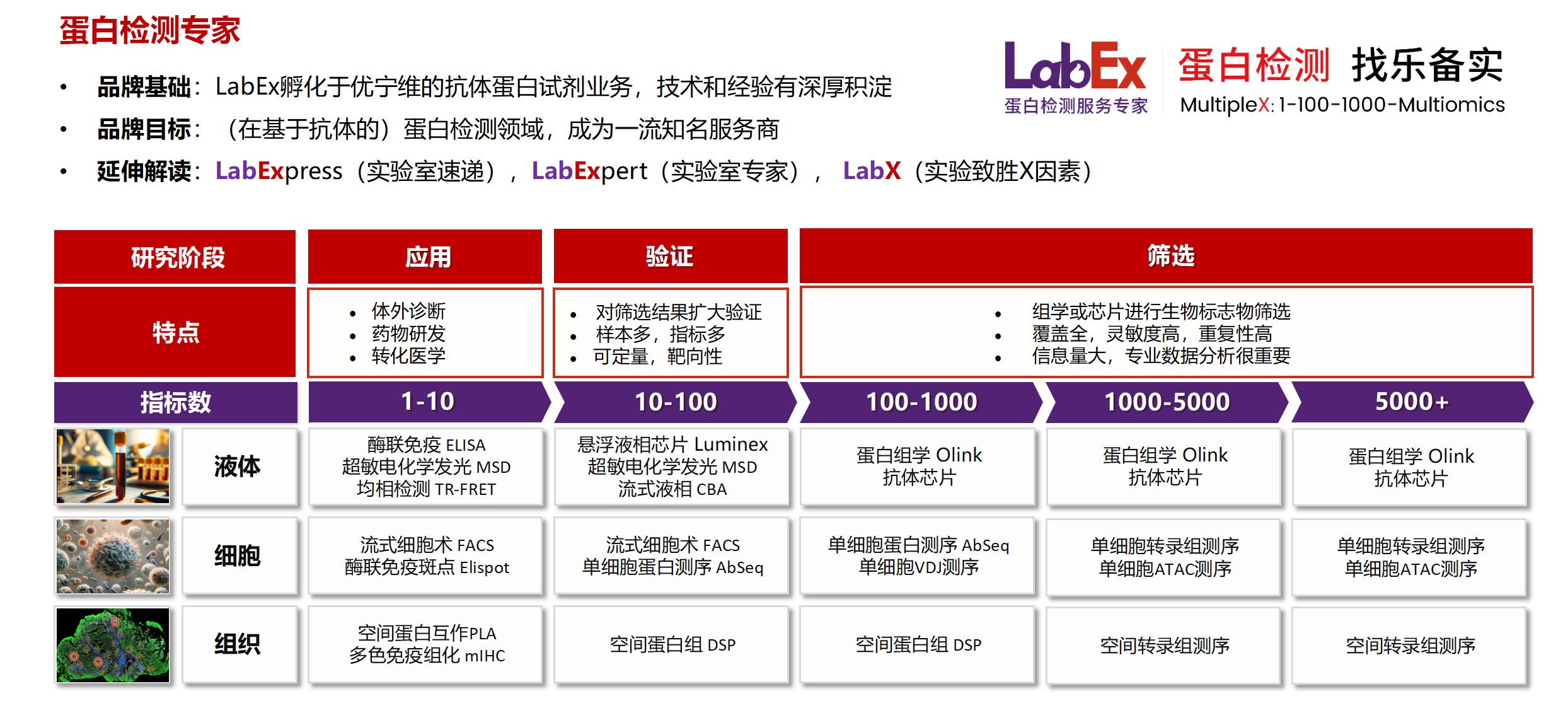
乐备实(上海优宁维生物科技股份有限公司旗下全资子公司),是国内专注于提供高质量蛋白检测以及组学分析服务的实验服务专家,自2018年成立以来,乐备实不断寻求突破,公司的服务技术平台已扩展到单细胞测序、空间多组学、流式检测、超敏电化学发光、Luminex多因子检测、抗体芯片、PCR Array、ELISA、Elispot、PLA蛋白互作、多色免疫组化、DSP空间多组学等30多个,建立起了一套涵盖基因、蛋白、细胞以及组织水平实验的完整检测体系。
我们可提供从样本运输、储存管理、样本制备、样本检测到检测数据分析的全流程服务。凭借严格的实验室管理流程、标准化实验室操作、原始数据储存体系以及实验项目管理系统,已经为超过3000家客户单位提供服务,年检测样本超过100万,受到了广大客户的信任与支持。
声明:本篇文章在创作中部分采用了人工智能辅助。如有任何内容涉及版权或知识产权问题,敬请告知,我们承诺将在第一时间核实并撤下。
详见LabEx网站(
www.u-labex.com)或来电咨询!
基因水平:PCR Array、RT-PCR、PCR、单细胞测序
蛋白水平:MSD、Luminex、CBA、Elispot、Antibody Array、ELISA、Sengenics
细胞水平:细胞染色、细胞分选、细胞培养、细胞功能
组织水平:空间多组学、多重荧光免疫组化、免疫组化、免疫荧光
数据分析:流式数据分析、组化数据分析、多因子数据分析
基因水平:PCR Array、RT-PCR、PCR、单细胞测序
蛋白水平:MSD、Luminex、CBA、Elispot、Antibody Array、ELISA、Sengenics
细胞水平:细胞染色、细胞分选、细胞培养、细胞功能
组织水平:空间多组学、多重荧光免疫组化、免疫组化、免疫荧光
数据分析:流式数据分析、组化数据分析、多因子数据分析
联系电话:4001619919
联系邮箱:labex-mkt@u-labex.com
公众平台:蛋白检测服务专家
联系邮箱:labex-mkt@u-labex.com
公众平台:蛋白检测服务专家




本网站销售的所有产品及服务均不得用于人类或动物之临床诊断或治疗,仅可用于工业或者科研等非医疗目的。

 沪公网安备31011502400759号
 营业执照(三证合一)

 labex-mkt@u-labex.com
 上海市浦东新区古丹路15弄18号楼4楼
请给“蛋白检测服务专家”公众号留言吧!我们客服当前在线哦