





Association of Clonal Hematopoiesis of Indeterminate Potential With Inflammatory Gene Expression in Patients With Severe Degenerative Aortic Valve Stenosis or Chronic Postischemic Heart Failure
浏览次数:59 分享: 


Importance: Cytokine release syndrome is a complication of coronavirus disease 2019. Clinically, advanced age and cardiovascular comorbidities are the most important risk factors. Objective: To determine whether clonal hematopoiesis of indeterminate potential (CHIP), an age-associated condition with excess cardiovascular risk defined as the presence of an expanded, mutated somatic blood cell clone in persons without other hematological abnormalities, may be associated with an inflammatory gene expression sensitizing monocytes to aggravated immune responses. Design, setting, and participants: This hypothesis-generating diagnostic study examined a cohort of patients with severe degenerative aortic valve stenosis or chronic postinfarction heart failure, as well as age-matched healthy control participants. Single-cell RNA sequencing and analyses of circulating peripheral monocytes was done between 2017 and 2019 to assess the transcriptome of circulating monocytes. Exposures: Severe degenerative aortic valve stenosis or chronic postinfarction heart failure. Main outcomes and measures: CHIP-driver sequence variations in monocytes with a proinflammatory signature of genes involved in cytokine release syndrome. Results: The study included 8 patients with severe degenerative aortic valve stenosis, 6 with chronic postinfarction heart failure, and 3 healthy control participants. Their mean age was 75.7 (range, 54-89) years, and 6 were women. Mean CHIP-driver gene variant allele frequency was 4.2% (range, 2.5%-6.9%) for DNMT3A and 14.3% (range, 2.6%-37.4%) for TET2. Participants with DNMT3A or TET2 CHIP-driver sequence variations displayed increased expression of interleukin 1β (no CHIP-driver sequence variations, 1.6217 normalized Unique Molecular Identifiers [nUMI]; DNMT3A, 5.3956 nUMI; P < .001; TET2, 10.8216 nUMI; P < .001), the interleukin 6 receptor (no CHIP-driver sequence variations, 0.5386 nUMI; DNMT3A, 0.9162 nUMI; P < .001;TET2, 0.5738 nUMI; P < .001), as well as the NLRP3 inflammasome complex (no CHIP-driver sequence variations, 0.4797 nUMI; DNMT3A, 0.9961 nUMI; P < .001; TET2, 1.2189 nUMI; P < .001), plus upregulation of CD163 (no CHIP-driver sequence variations, 0.5239 nUMI; DNMT3A, 1.4722 nUMI; P < .001; TET2, 1.0684 nUMI; P < .001), a cellular receptor capable of mediating infection, macrophage activation syndrome, and other genes involved in cytokine response syndrome. Gene ontology term analyses of regulated genes revealed that the most significantly upregulated genes encode for leukocyte-activation and interleukin-signaling pathways in monocytes of individuals with DNMT3A (myeloid leukocyte activation: log[Q value], -50.1986; log P value, -54.5177; regulation of cytokine production: log[Q value], -21.0264; log P value, -24.1993; signaling by interleukins: log[Q value], -18.0710: log P value, -21.1597) or TET2 CHIP-driver sequence variations (immune response: log[Q value], -36.3673; log P value, -40.6864; regulation of cytokine production: log[Q value], -13.1733; log P value, -16.3463; signaling by interleukins: log[Q value], -12.6547: log P value, -15.7977). Conclusions and relevance: Monocytes of individuals who carry CHIP-driver sequence variations and have cardiovascular disease appear to be primed for excessive inflammatory responses. Further studies are warranted to address potential adverse outcomes of coronavirus disease 2019 in patients with CHIP-driver sequence variations.
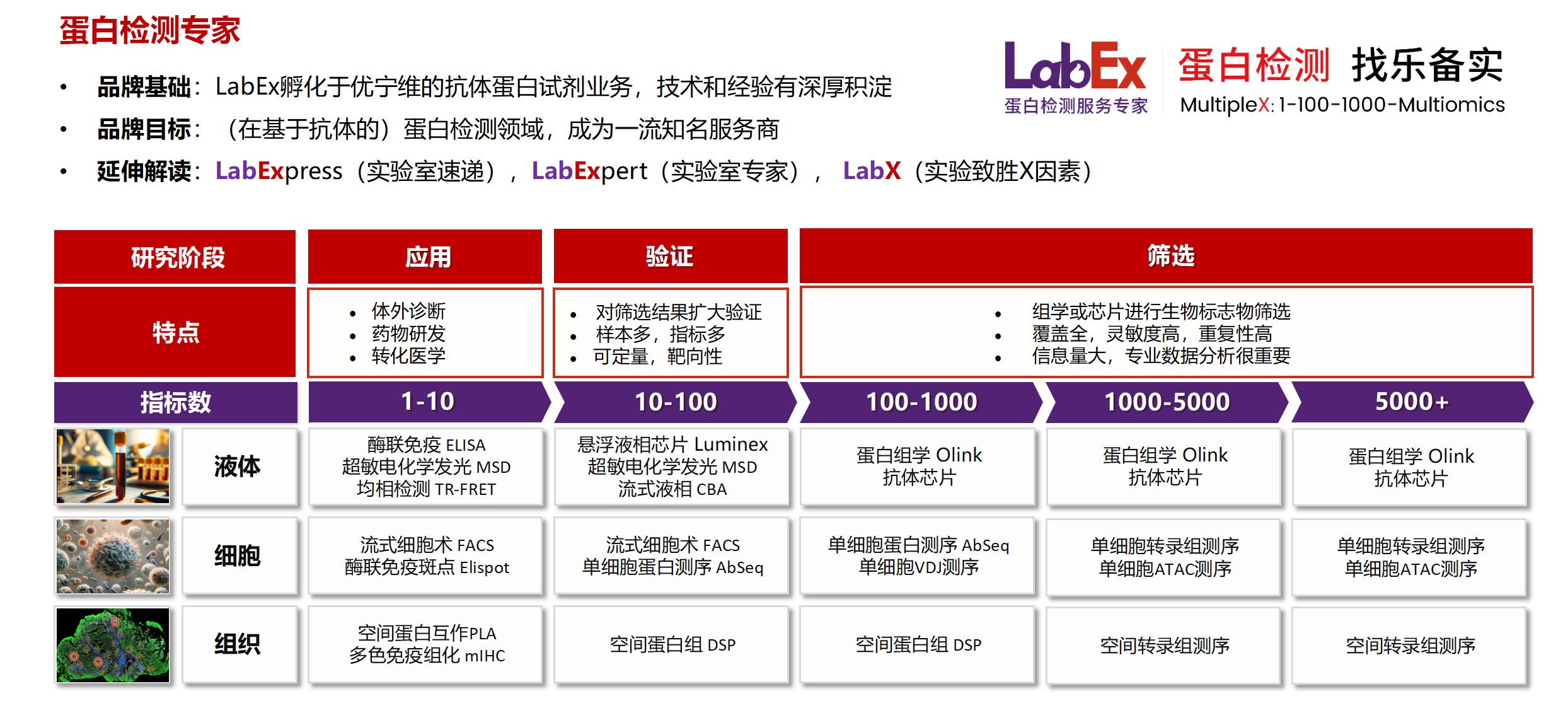
乐备实是国内专注于提供高质量蛋白检测以及组学分析服务的实验服务专家,自2018年成立以来,乐备实不断寻求突破,公司的服务技术平台已扩展到单细胞测序、空间多组学、流式检测、超敏电化学发光、Luminex多因子检测、抗体芯片、PCR Array、ELISA、Elispot、PLA蛋白互作、多色免疫组化、DSP空间多组学等30多个,建立起了一套涵盖基因、蛋白、细胞以及组织水平实验的完整检测体系。
我们可提供从样本运输、储存管理、样本制备、样本检测到检测数据分析的全流程服务。凭借严格的实验室管理流程、标准化实验室操作、原始数据储存体系以及实验项目管理系统,已经为超过3000家客户单位提供服务,年检测样本超过100万,受到了广大客户的信任与支持。
声明:本篇文章在创作中部分采用了人工智能辅助。如有任何内容涉及版权或知识产权问题,敬请告知,我们承诺将在第一时间核实并撤下。
详见LabEx网站(
www.u-labex.com)或来电咨询!
基因水平:PCR Array、RT-PCR、PCR、单细胞测序
蛋白水平:MSD、Luminex、CBA、Elispot、Antibody Array、ELISA、Sengenics
细胞水平:细胞染色、细胞分选、细胞培养、细胞功能
组织水平:空间多组学、多重荧光免疫组化、免疫组化、免疫荧光
数据分析:流式数据分析、组化数据分析、多因子数据分析
基因水平:PCR Array、RT-PCR、PCR、单细胞测序
蛋白水平:MSD、Luminex、CBA、Elispot、Antibody Array、ELISA、Sengenics
细胞水平:细胞染色、细胞分选、细胞培养、细胞功能
组织水平:空间多组学、多重荧光免疫组化、免疫组化、免疫荧光
数据分析:流式数据分析、组化数据分析、多因子数据分析
联系电话:4001619919
联系邮箱:labex-mkt@u-labex.com
公众平台:蛋白检测服务专家
联系邮箱:labex-mkt@u-labex.com
公众平台:蛋白检测服务专家




本网站销售的所有产品及服务均不得用于人类或动物之临床诊断或治疗,仅可用于工业或者科研等非医疗目的。

 沪公网安备31011502400759号
 营业执照(三证合一)

 labex-mkt@u-labex.com
 上海市浦东新区古丹路15弄18号楼4楼

请给“蛋白检测服务专家”公众号留言吧!我们客服当前在线哦