





Computational Solutions for Spatial Transcriptomics
浏览次数:228 分享: 


Transcriptome level expression data connected to the spatial organization of the cells and molecules would allow a comprehensive understanding of how gene expression is connected to the structure and function in the biological systems. The spatial transcriptomics platforms may soon provide such information. However, the current platforms still lack spatial resolution, capture only a fraction of the transcriptome heterogeneity, or lack the throughput for large scale studies. The strengths and weaknesses in current ST platforms and computational solutions need to be taken into account when planning spatial transcriptomics studies. The basis of the computational ST analysis is the solutions developed for single-cell RNA-sequencing data, with advancements taking into account the spatial connectedness of the transcriptomes. The scRNA-seq tools are modified for spatial transcriptomics or new solutions like deep learning-based joint analysis of expression, spatial, and image data are developed to extract biological information in the spatially resolved transcriptomes. The computational ST analysis can reveal remarkable biological insights into spatial patterns of gene expression, cell signaling, and cell type variations in connection with cell type-specific signaling and organization in complex tissues. This review covers the topics that help choosing the platform and computational solutions for spatial transcriptomics research. We focus on the currently available ST methods and platforms and their strengths and limitations. Of the computational solutions, we provide an overview of the analysis steps and tools used in the ST data analysis. The compatibility with the data types and the tools provided by the current ST analysis frameworks are summarized. Keywords: AOI, area of illumination; BICCN, Brain Initiative Cell Census Network; BOLORAMIS, barcoded oligonucleotides ligated on RNA amplified for multiplexed and parallel in situ analyses; Baysor, Bayesian Segmentation of Spatial Transcriptomics Data; BinSpect, Binary Spatial Extraction; CCC, cell–cell communication; CCI, cell–cell interactions; CNV, copy-number variation; Computational biology; DSP, digital spatial profiling; DbiT-Seq, Deterministic Barcoding in Tissue for spatial omics sequencing; FA, factor analysis; FFPE, formalin-fixed, paraffin-embedded; FISH, fluorescence in situ hybridization; FISSEQ, fluorescence in situ sequencing of RNA; FOV, Field of view; GRNs, gene regulation networks; GSEA, gene set enrichment analysis; GSVA, gene set variation analysis; HDST, high definition spatial transcriptomics; HMRF, hidden Markov random field; ICG, interaction changed genes; ISH, in situ hybridization; ISS, in situ sequencing; JSTA, Joint cell segmentation and cell type annotation; KNN, k-nearest neighbor; LCM, Laser Capture Microdissection; LCM-seq, laser capture microdissection coupled with RNA sequencing; LOH, loss of heterozygosity analysis; MC, Molecular Cartography; MERFISH, multiplexed error-robust FISH; NMF (NNMF), Non-negative matrix factorization; PCA, Principal Component Analysis; PIXEL-seq, Polony (or DNA cluster)-indexed library-sequencing; PL-lig, padlock ligation; QC, quality control; RNAseq, RNA sequencing; ROI, region of interest; SCENIC, Single-Cell rEgulatory Network Inference and Clustering; SME, Spatial Morphological gene Expression normalization; SPATA, SPAtial Transcriptomic Analysis; ST Pipeline, Spatial Transcriptomics Pipeline; ST, Spatial transcriptomics; STARmap, spatially-resolved transcript amplicon readout mapping; Single-cell analysis; Spatial data analysis frameworks; Spatial deconvolution; Spatial transcriptomics; TIVA, Transcriptome in Vivo Analysis; TMA, tissue microarray; TME, tumor micro environment; UMAP, Uniform Manifold Approximation and Projection for Dimension Reduction; UMI, unique molecular identifier; ZipSeq, zipcoded sequencing.; scRNA-seq, single-cell RNA sequencing; scvi-tools, single-cell variational inference tools; seqFISH, sequential fluorescence in situ hybridization; sequ-smFISH, sequential single-molecule fluorescent in situ hybridization; smFISH, single molecule FISH; t-SNE, t-distributed stochastic neighbor embedding.
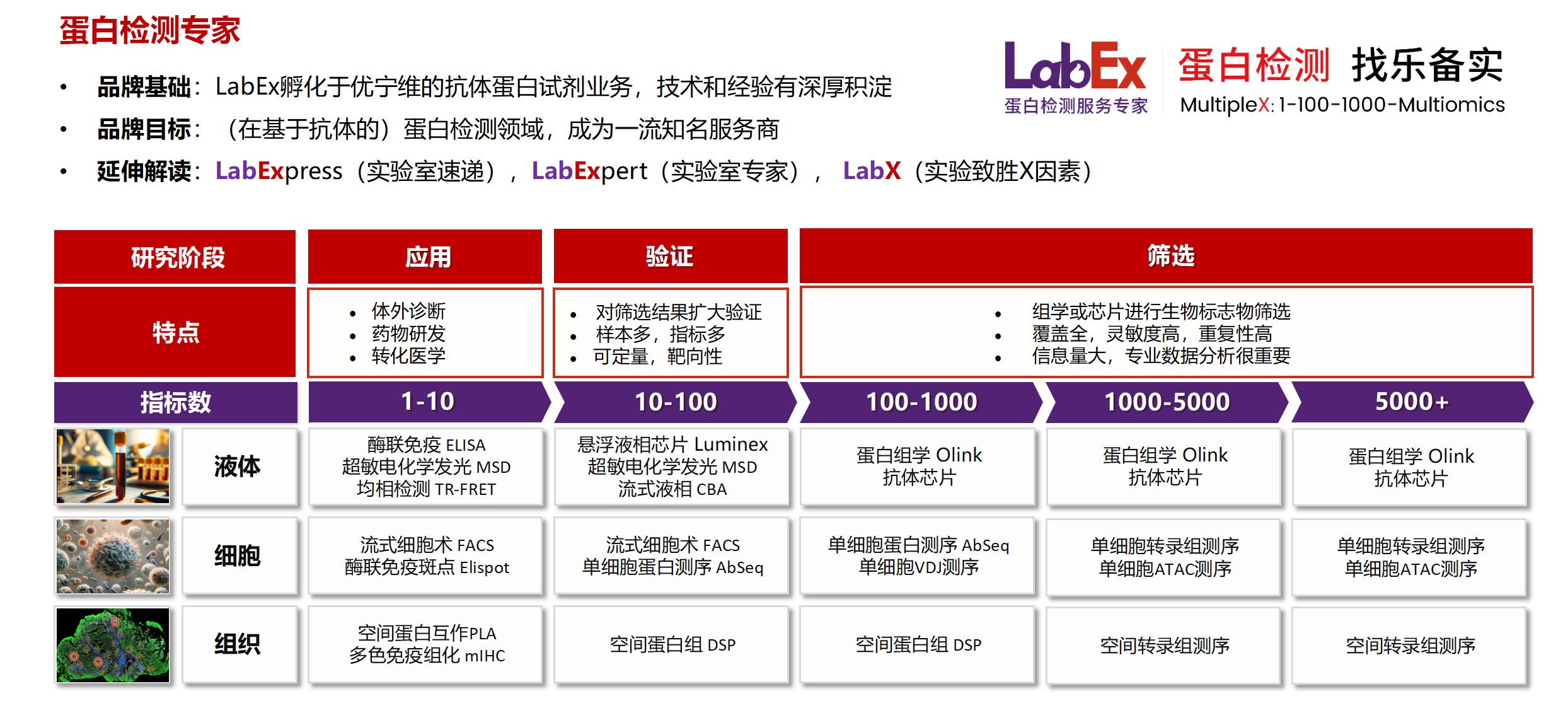
乐备实(上海优宁维生物科技股份有限公司旗下全资子公司),是国内专注于提供高质量蛋白检测以及组学分析服务的实验服务专家,自2018年成立以来,乐备实不断寻求突破,公司的服务技术平台已扩展到单细胞测序、空间多组学、流式检测、超敏电化学发光、Luminex多因子检测、抗体芯片、PCR Array、ELISA、Elispot、PLA蛋白互作、多色免疫组化、DSP空间多组学等30多个,建立起了一套涵盖基因、蛋白、细胞以及组织水平实验的完整检测体系。
我们可提供从样本运输、储存管理、样本制备、样本检测到检测数据分析的全流程服务。凭借严格的实验室管理流程、标准化实验室操作、原始数据储存体系以及实验项目管理系统,已经为超过3000家客户单位提供服务,年检测样本超过100万,受到了广大客户的信任与支持。
声明:本篇文章在创作中部分采用了人工智能辅助。如有任何内容涉及版权或知识产权问题,敬请告知,我们承诺将在第一时间核实并撤下。
详见LabEx网站(
www.u-labex.com)或来电咨询!
基因水平:PCR Array、RT-PCR、PCR、单细胞测序
蛋白水平:MSD、Luminex、CBA、Elispot、Antibody Array、ELISA、Sengenics
细胞水平:细胞染色、细胞分选、细胞培养、细胞功能
组织水平:空间多组学、多重荧光免疫组化、免疫组化、免疫荧光
数据分析:流式数据分析、组化数据分析、多因子数据分析
基因水平:PCR Array、RT-PCR、PCR、单细胞测序
蛋白水平:MSD、Luminex、CBA、Elispot、Antibody Array、ELISA、Sengenics
细胞水平:细胞染色、细胞分选、细胞培养、细胞功能
组织水平:空间多组学、多重荧光免疫组化、免疫组化、免疫荧光
数据分析:流式数据分析、组化数据分析、多因子数据分析
联系电话:4001619919
联系邮箱:labex-mkt@u-labex.com
公众平台:蛋白检测服务专家
联系邮箱:labex-mkt@u-labex.com
公众平台:蛋白检测服务专家




本网站销售的所有产品及服务均不得用于人类或动物之临床诊断或治疗,仅可用于工业或者科研等非医疗目的。

 沪公网安备31011502400759号
 营业执照(三证合一)

 labex-mkt@u-labex.com
 上海市浦东新区古丹路15弄18号楼4楼
请给“蛋白检测服务专家”公众号留言吧!我们客服当前在线哦