





Over 150 000 Americans are diagnosed with colorectal cancer (CRC) every year, and annually over 50 000 individuals will die from CRC, necessitating improvements in screening, prognostication, disease management, and therapeutic options. Tumor metastasis is the primary factor related to the risk of recurrence and mortality. Yet, screening for nodal and distant metastasis is costly, and invasive and incomplete resection may hamper adequate assessment. Signatures of the tumor-immune microenvironment (TIME) at the primary site can provide valuable insights into the aggressiveness of the tumor and the effectiveness of various treatment options. Spatially resolved transcriptomics technologies offer an unprecedented characterization of TIME through high multiplexing, yet their scope is constrained by cost. Meanwhile, it has long been suspected that histological, cytological, and macroarchitectural tissue characteristics correlate well with molecular information (e.g., gene expression). Thus, a method for predicting transcriptomics data through inference of RNA patterns from whole slide images (WSI) is a key step in studying metastasis at scale. In this work, we collected tissue from 4 stage-III (pT3) matched colorectal cancer patients for spatial transcriptomics profiling. The Visium spatial transcriptomics (ST) assay was used to measure transcript abundance for 17 943 genes at up to 5000 55-micron (i.e., 1-10 cells) spots per patient sampled in a honeycomb pattern, co-registered with hematoxylin and eosin (H&E) stained WSI. The Visium ST assay can measure expression at these spots through tissue permeabilization of mRNAs, which are captured through spatially (i.e., x-y positional coordinates) barcoded, gene specific oligo probes. WSI subimages were extracted around each co-registered Visium spot and were used to predict the expression at these spots using machine learning models. We prototyped and compared several convolutional, transformer, and graph convolutional neural networks to predict spatial RNA patterns at the Visium spots under the hypothesis that the transformer- and graph-based approaches better capture relevant spatial tissue architecture. We further analyzed the model's ability to recapitulate spatial autocorrelation statistics using SPARK and SpatialDE. Overall, the results indicate that the transformer- and graph-based approaches were unable to outperform the convolutional neural network architecture, though they exhibited optimal performance for relevant disease-associated genes. Initial findings suggest that different neural networks that operate on different scales are relevant for capturing distinct disease pathways (e.g., epithelial to mesenchymal transition). We add further evidence that deep learning models can accurately predict gene expression in whole slide images and comment on understudied factors which may increase its external applicability (e.g., tissue context). Our preliminary work will motivate further investigation of inference for molecular patterns from whole slide images as metastasis predictors and in other applications.
Keywords:Colorectal cancer; Deep learning; Graph neural network; Histomorphology; Spatial transcriptomics; Transformers.
Inferring spatial transcriptomics markers from whole slide images to characterize metastasis-related spatial heterogeneity of colorectal tumors: A pilot study
浏览次数:75 分享: 


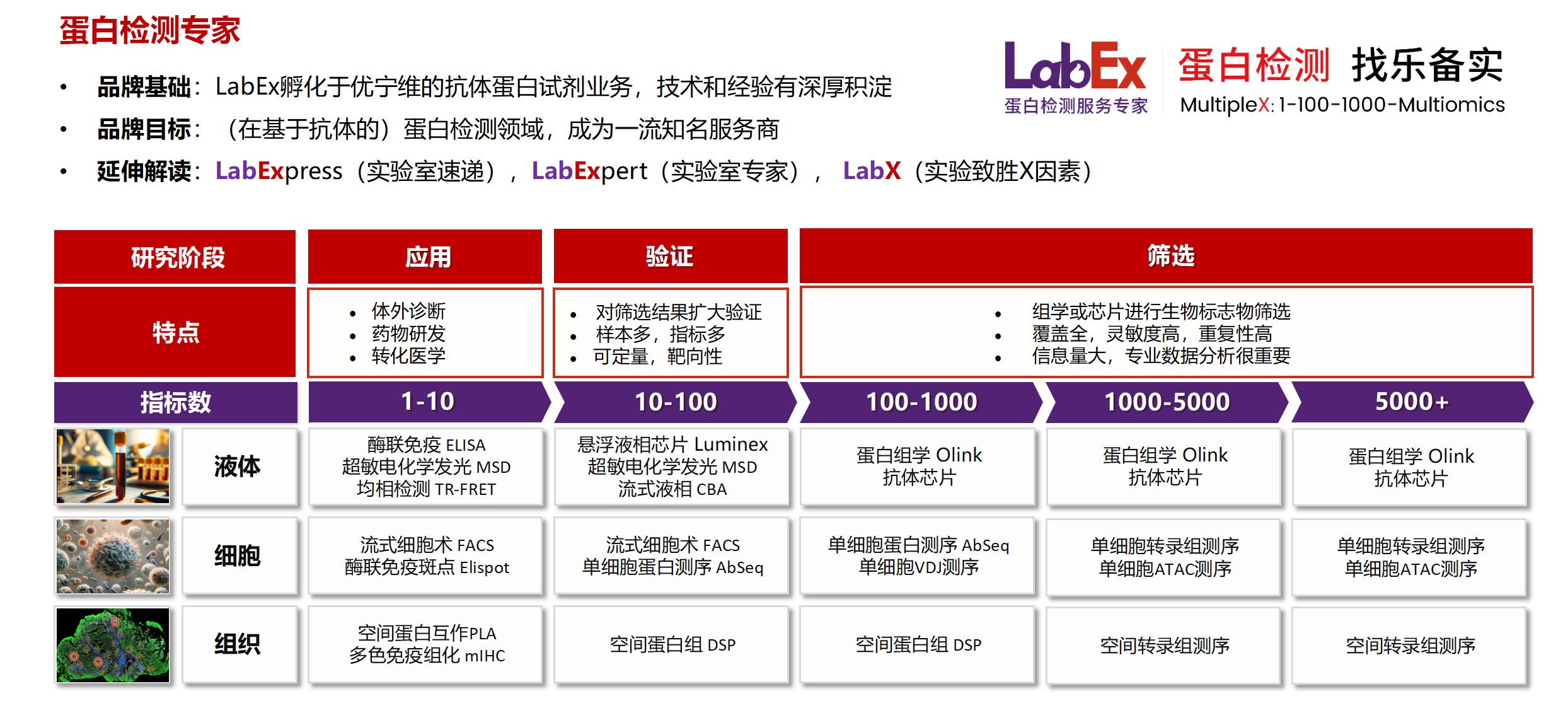
乐备实(上海优宁维生物科技股份有限公司旗下全资子公司),是国内专注于提供高质量蛋白检测以及组学分析服务的实验服务专家,自2018年成立以来,乐备实不断寻求突破,公司的服务技术平台已扩展到单细胞测序、空间多组学、流式检测、超敏电化学发光、Luminex多因子检测、抗体芯片、PCR Array、ELISA、Elispot、PLA蛋白互作、多色免疫组化、DSP空间多组学等30多个,建立起了一套涵盖基因、蛋白、细胞以及组织水平实验的完整检测体系。
我们可提供从样本运输、储存管理、样本制备、样本检测到检测数据分析的全流程服务。凭借严格的实验室管理流程、标准化实验室操作、原始数据储存体系以及实验项目管理系统,已经为超过3000家客户单位提供服务,年检测样本超过100万,受到了广大客户的信任与支持。
声明:本篇文章在创作中部分采用了人工智能辅助。如有任何内容涉及版权或知识产权问题,敬请告知,我们承诺将在第一时间核实并撤下。
详见LabEx网站(
www.u-labex.com)或来电咨询!
基因水平:PCR Array、RT-PCR、PCR、单细胞测序
蛋白水平:MSD、Luminex、CBA、Elispot、Antibody Array、ELISA、Sengenics
细胞水平:细胞染色、细胞分选、细胞培养、细胞功能
组织水平:空间多组学、多重荧光免疫组化、免疫组化、免疫荧光
数据分析:流式数据分析、组化数据分析、多因子数据分析
基因水平:PCR Array、RT-PCR、PCR、单细胞测序
蛋白水平:MSD、Luminex、CBA、Elispot、Antibody Array、ELISA、Sengenics
细胞水平:细胞染色、细胞分选、细胞培养、细胞功能
组织水平:空间多组学、多重荧光免疫组化、免疫组化、免疫荧光
数据分析:流式数据分析、组化数据分析、多因子数据分析
联系电话:4001619919
联系邮箱:labex-mkt@u-labex.com
公众平台:蛋白检测服务专家
联系邮箱:labex-mkt@u-labex.com
公众平台:蛋白检测服务专家




本网站销售的所有产品及服务均不得用于人类或动物之临床诊断或治疗,仅可用于工业或者科研等非医疗目的。

 沪公网安备31011502400759号
 营业执照(三证合一)

 labex-mkt@u-labex.com
 上海市浦东新区古丹路15弄18号楼4楼
请给“蛋白检测服务专家”公众号留言吧!我们客服当前在线哦