





The miR-221/222 cluster regulates hematopoietic stem cell quiescence and multipotency by suppressing both Fos/AP-1/IEG pathway activation and stress-like differentiation to granulocytes
浏览次数:126 分享: 


Throughout life, hematopoietic stem cells (HSCs), residing in bone marrow (BM), continuously regenerate erythroid/megakaryocytic, myeloid, and lymphoid cell lineages. This steady-state hematopoiesis from HSC and multipotent progenitors (MPPs) in BM can be perturbed by stress. The molecular controls of how stress can impact hematopoietic output remain poorly understood. MicroRNAs (miRNAs) as posttranscriptional regulators of gene expression have been found to control various functions in hematopoiesis. We find that the miR-221/222 cluster, which is expressed in HSC and in MPPs differentiating from them, perturbs steady-state hematopoiesis in ways comparable to stress. We compare pool sizes and single-cell transcriptomes of HSC and MPPs in unperturbed or stress-perturbed, miR-221/222-proficient or miR-221/222-deficient states. MiR-221/222 deficiency in hematopoietic cells was induced in C57BL/6J mice by conditional vav-cre-mediated deletion of the floxed miR-221/222 gene cluster. Social stress as well as miR-221/222 deficiency, alone or in combination, reduced HSC pools 3-fold and increased MPPs 1.5-fold. It also enhanced granulopoisis in the spleen. Furthermore, combined stress and miR-221/222 deficiency increased the erythroid/myeloid/granulocytic precursor pools in BM. Differential expression analyses of single-cell RNAseq transcriptomes of unperturbed and stressed, proficient HSC and MPPs detected more than 80 genes, selectively up-regulated in stressed cells, among them immediate early genes (IEGs). The same differential single-cell transcriptome analyses of unperturbed, miR-221/222-proficient with deficient HSC and MPPs identified Fos, Jun, JunB, Klf6, Nr4a1, Ier2, Zfp36-all IEGs-as well as CD74 and Ly6a as potential miRNA targets. Three of them, Klf6, Nr4a1, and Zfp36, have previously been found to influence myelogranulopoiesis. Together with increased levels of Jun, Fos forms increased amounts of the heterodimeric activator protein-1 (AP-1), which is known to control the expression of the selectively up-regulated expression of the IEGs. The comparisons of single-cell mRNA-deep sequencing analyses of socially stressed with miR-221/222-deficient HSC identify 5 of the 7 Fos/AP-1-controlled IEGs, Ier2, Jun, Junb, Klf6, and Zfp36, as common activators of HSC from quiescence. Combined with stress, miR-221/222 deficiency enhanced the Fos/AP-1/IEG pathway, extended it to MPPs, and increased the number of granulocyte precursors in BM, inducing selective up-regulation of genes encoding heat shock proteins Hspa5 and Hspa8, tubulin-cytoskeleton-organizing proteins Tuba1b, Tubb 4b and 5, and chromatin remodeling proteins H3f3b, H2afx, H2afz, and Hmgb2. Up-regulated in HSC, MPP1, and/or MPP2, they appear as potential regulators of stress-induced, miR-221/222-dependent increased granulocyte differentiation. Finally, stress by serial transplantations of miR-221/222-deficient HSC selectively exhausted their lymphoid differentiation capacities, while retaining their ability to home to BM and to differentiate to granulocytes. Thus, miR-221/222 maintains HSC quiescence and multipotency by suppressing Fos/AP-1/IEG-mediated activation and by suppressing enhanced stress-like differentiation to granulocytes. Since miR-221/222 is also expressed in human HSC, controlled induction of miR-221/222 in HSC should improve BM transplantations.
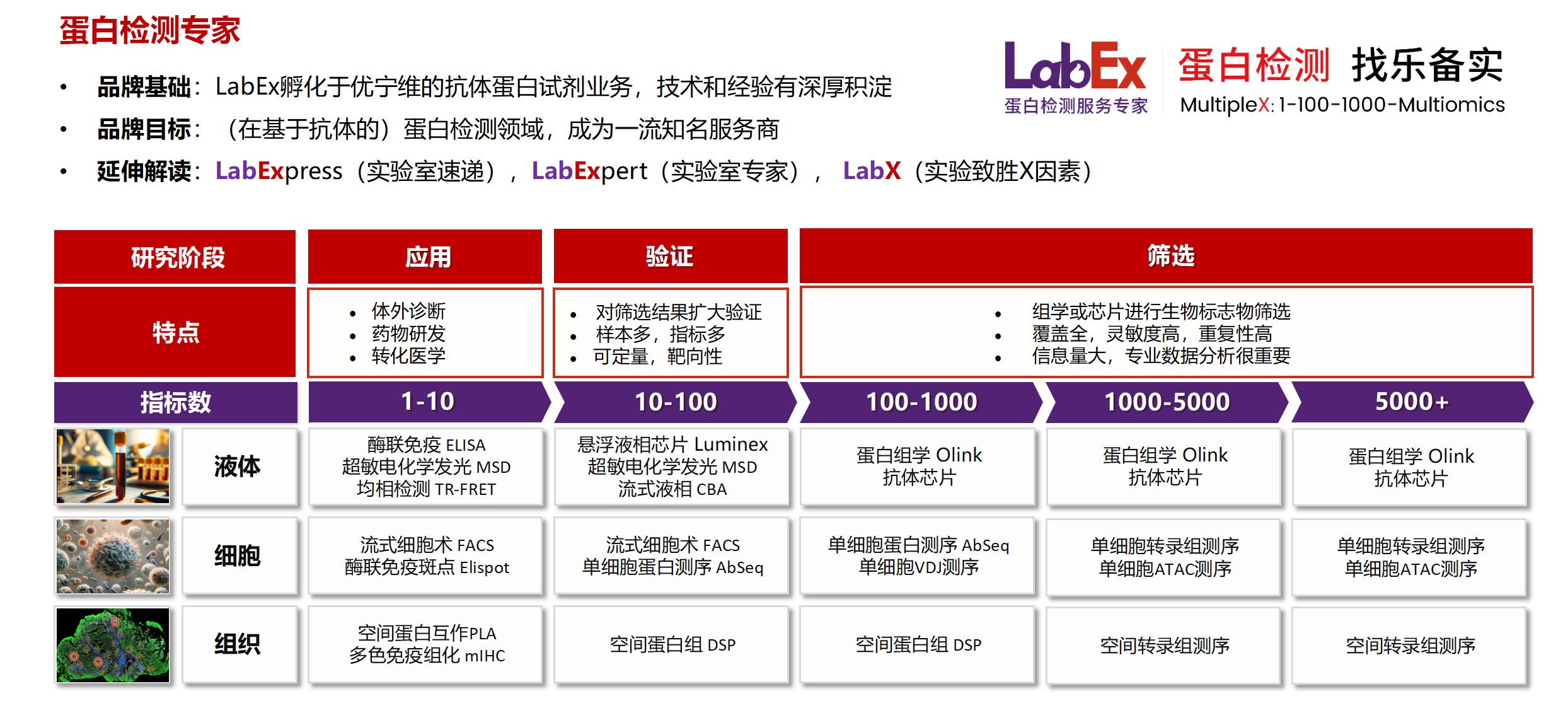
乐备实(上海优宁维生物科技股份有限公司旗下全资子公司),是国内专注于提供高质量蛋白检测以及组学分析服务的实验服务专家,自2018年成立以来,乐备实不断寻求突破,公司的服务技术平台已扩展到单细胞测序、空间多组学、流式检测、超敏电化学发光、Luminex多因子检测、抗体芯片、PCR Array、ELISA、Elispot、PLA蛋白互作、多色免疫组化、DSP空间多组学等30多个,建立起了一套涵盖基因、蛋白、细胞以及组织水平实验的完整检测体系。
我们可提供从样本运输、储存管理、样本制备、样本检测到检测数据分析的全流程服务。凭借严格的实验室管理流程、标准化实验室操作、原始数据储存体系以及实验项目管理系统,已经为超过3000家客户单位提供服务,年检测样本超过100万,受到了广大客户的信任与支持。
声明:本篇文章在创作中部分采用了人工智能辅助。如有任何内容涉及版权或知识产权问题,敬请告知,我们承诺将在第一时间核实并撤下。
详见LabEx网站(
www.u-labex.com)或来电咨询!
基因水平:PCR Array、RT-PCR、PCR、单细胞测序
蛋白水平:MSD、Luminex、CBA、Elispot、Antibody Array、ELISA、Sengenics
细胞水平:细胞染色、细胞分选、细胞培养、细胞功能
组织水平:空间多组学、多重荧光免疫组化、免疫组化、免疫荧光
数据分析:流式数据分析、组化数据分析、多因子数据分析
基因水平:PCR Array、RT-PCR、PCR、单细胞测序
蛋白水平:MSD、Luminex、CBA、Elispot、Antibody Array、ELISA、Sengenics
细胞水平:细胞染色、细胞分选、细胞培养、细胞功能
组织水平:空间多组学、多重荧光免疫组化、免疫组化、免疫荧光
数据分析:流式数据分析、组化数据分析、多因子数据分析
联系电话:4001619919
联系邮箱:labex-mkt@u-labex.com
公众平台:蛋白检测服务专家
联系邮箱:labex-mkt@u-labex.com
公众平台:蛋白检测服务专家




本网站销售的所有产品及服务均不得用于人类或动物之临床诊断或治疗,仅可用于工业或者科研等非医疗目的。

 沪公网安备31011502400759号
 营业执照(三证合一)

 labex-mkt@u-labex.com
 上海市浦东新区古丹路15弄18号楼4楼

请给“蛋白检测服务专家”公众号留言吧!我们客服当前在线哦