





Background:Early diagnosis and accurate prognosis of cognitive decline in Alzheimer's disease (AD) is important to timely assignment to optimal treatment modes. We aimed to develop a deep learning model to predict cognitive conversion to guide re-assignment decisions to more intensive therapies where needed.
Methods:Longitudinal data including five variable sets, i.e. demographics, medical history, neuropsychological outcomes, laboratory and neuroimaging results, from the Alzheimer's Disease Neuroimaging Initiative (ADNI) cohort were analyzed. We first developed a deep learning model to predicted cognitive conversion using all five variable sets. We then gradually removed variable sets to obtained parsimonious models for four different years of forecasting after baseline within acceptable frames of reduction in overall model fit (AUC remaining > 0.8).
Results:A total of 607 individuals were included at baseline, of whom 538 participants were followed up at 12 months, 482 at 24 months, 268 at 36 months and 280 at 48 months. Predictive performance was excellent with AUCs ranging from 0.87 to 0.92 when all variable sets were considered. Parsimonious prediction models that still had a good performance with AUC 0.80-0.84 were established, each only including two variable sets. Neuropsychological outcomes were included in all parsimonious models. In addition, biomarker was included at year 1 and year 2, imaging data at year 3 and demographics at year 4. Under our pre-set threshold, the rate of upgrade to more intensive therapies according to predicted cognitive conversion was always higher than according to actual cognitive conversion so as to decrease the false positive rate, indicating the proportion of patients who would have missed upgraded treatment based on prognostic models although they actually needed it.
Conclusions:Neurophysiological tests combined with other indicator sets that vary along the AD continuum can improve can provide aid for clinical treatment decisions leading to improved management of the disease.
Trail registration information:ClinicalTrials.gov Identifier: NCT00106899 (Registration Date: 31 March 2005).
Keywords:Alzheimer’s disease; Cognitive conversion; Machine learning; Prediction model.
Prediction of cognitive conversion within the Alzheimer's disease continuum using deep learning
浏览次数:5 分享: 


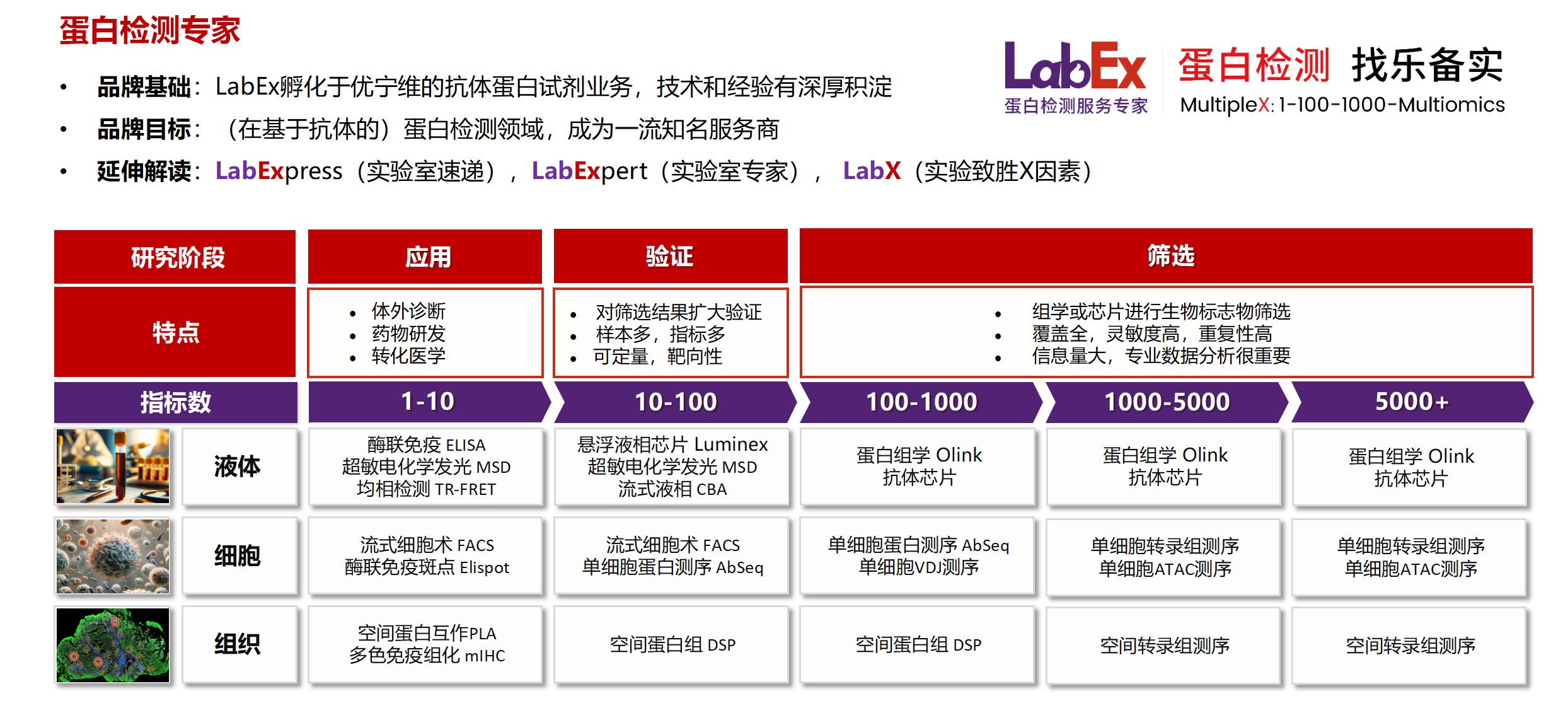
乐备实(上海优宁维生物科技股份有限公司旗下全资子公司),是国内专注于提供高质量蛋白检测以及组学分析服务的实验服务专家,自2018年成立以来,乐备实不断寻求突破,公司的服务技术平台已扩展到单细胞测序、空间多组学、流式检测、超敏电化学发光、Luminex多因子检测、抗体芯片、PCR Array、ELISA、Elispot、PLA蛋白互作、多色免疫组化、DSP空间多组学等30多个,建立起了一套涵盖基因、蛋白、细胞以及组织水平实验的完整检测体系。
我们可提供从样本运输、储存管理、样本制备、样本检测到检测数据分析的全流程服务。凭借严格的实验室管理流程、标准化实验室操作、原始数据储存体系以及实验项目管理系统,已经为超过3000家客户单位提供服务,年检测样本超过100万,受到了广大客户的信任与支持。
声明:本篇文章在创作中部分采用了人工智能辅助。如有任何内容涉及版权或知识产权问题,敬请告知,我们承诺将在第一时间核实并撤下。
详见LabEx网站(
www.u-labex.com)或来电咨询!
基因水平:PCR Array、RT-PCR、PCR、单细胞测序
蛋白水平:MSD、Luminex、CBA、Elispot、Antibody Array、ELISA、Sengenics
细胞水平:细胞染色、细胞分选、细胞培养、细胞功能
组织水平:空间多组学、多重荧光免疫组化、免疫组化、免疫荧光
数据分析:流式数据分析、组化数据分析、多因子数据分析
基因水平:PCR Array、RT-PCR、PCR、单细胞测序
蛋白水平:MSD、Luminex、CBA、Elispot、Antibody Array、ELISA、Sengenics
细胞水平:细胞染色、细胞分选、细胞培养、细胞功能
组织水平:空间多组学、多重荧光免疫组化、免疫组化、免疫荧光
数据分析:流式数据分析、组化数据分析、多因子数据分析
联系电话:4001619919
联系邮箱:labex-mkt@u-labex.com
公众平台:蛋白检测服务专家
联系邮箱:labex-mkt@u-labex.com
公众平台:蛋白检测服务专家




本网站销售的所有产品及服务均不得用于人类或动物之临床诊断或治疗,仅可用于工业或者科研等非医疗目的。

 沪公网安备31011502400759号
 营业执照(三证合一)

 labex-mkt@u-labex.com
 上海市浦东新区古丹路15弄18号楼4楼
请给“蛋白检测服务专家”公众号留言吧!我们客服当前在线哦